Start with the planning decision
More model detail is not automatically better.
Define the question and required level of confidence, then scope the monitoring, survey, model extent, and alternatives around it. That helps make additional engineering effort proportional to the decision.
A focused capacity-assessment workflow
Define the decision and design conditions
Identify proposed development, known surcharging, seasonal system behavior, and the storm or flow conditions the agency needs to evaluate.
Collect reliable data
Use available record drawings, targeted manhole survey, flow monitoring, rainfall, and operational observations to improve the representation of the actual system.
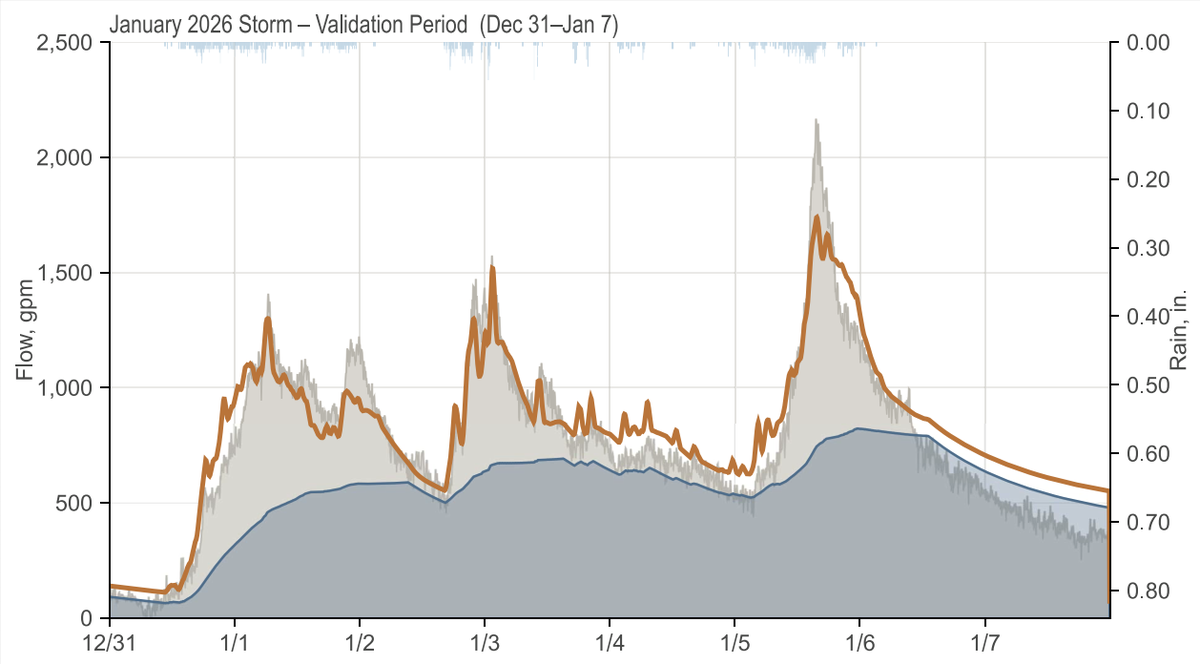
Calibrate for the relevant flows
Account for dry-weather patterns and rainfall-derived infiltration and inflow (RDII) where these affect the decision. Document how observations support the modeled response.
Evaluate alternatives
Test where constraints occur and which combination of modifications can provide adequate capacity, considering constructability and maintenance access as well as hydraulics.
Transfer the working knowledge
Document assumptions and train agency staff to interpret and update the model as conditions change.
Two ways this changes projects
San Rafael: evaluating development-related capacity
EEI's downtown collection-system study uses a 2,200-node EPA SWMM model, approximately 285 manhole surveys, and six new flow meters to evaluate wet-weather capacity and locate constraints for a 10-year, 24-hour storm. Staff training is included.
See the project →
Pacifica: reducing the extent of planned construction
Hydraulic modeling and improvement of a trunk-sewer manhole's approaches allowed elimination of approximately 900 feet of planned upsizing along Linda Mar Boulevard, while also addressing maintenance access.
See the project →Questions to ask before commissioning a model
- Which specific capital, development, or operating decision must the model support?
- What survey or monitoring uncertainty would be most likely to change the answer?
- Are we testing alternatives to long-segment upsizing or only a single proposed solution?
- How will agency staff use and maintain the model after delivery?
The examples reflect specific agency projects, not generalized guarantees of modeled outcomes. Appropriate analysis and design criteria are system-specific.